
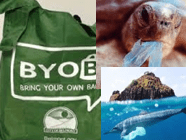
 What glides down our highways, blows through cities, catches in trees, floats down rivers, washes up on beaches—and is a hot topic in communities from Albuquerque to Abu Dhabi?
Answer: the common plastic grocery bag!
For all its convenience, the disposable plastic grocery bag has become, well…a tad inconvenient.
While paper bags carry a significant environmental footprint, it’s the ubiquitous, non-biodegradable plastic bag that shows up in all the wrong places. In some locations, plastic bag litter is so prevalent it has earned nicknames such as “white pollution” (China) and “the national flower” (South Africa).
Consider this: in 2012, volunteers picked up 1,019,902 various types of plastic bags and bag pieces from coastlines across the globe—mostly over the course of a single day.[1] That’s more than one million plastic bags or bag bits found in places they shouldn’t be, in a 24-hour period. Whoa!
How many bags are out there? Invented by a Swedish engineer in the early 1960s, the modern, lightweight plastic bag became commonplace in the 1980s, used primarily for carrying daily groceries from the store to vehicles and homes throughout the developed world. Today, approximately 100 billion plastic bags are used annually in the United States alone.[2] According to some estimates, between 500 billion and 1 trillion plastic bags are used each year worldwide.[3]
Where do they all go? Once plastic grocery bags are used (or re-used), they can be carted off to the landfill or even recycled (if properly cleaned). However, despite our best efforts to reuse, recycle, and contain them, they have a way of getting into our environment—and staying there. Carried by a gust of wind, these aerodynamic bags escape from cars, boats, picnic tables, landfills, dumpsters, and garbage trucks.
They lodge somewhere in the landscape or travel down our waterways and into the ocean. More than an eyesore, plastic bags can sometimes be harmful to wildlife—such as turtles, birds, and seals who can become entangled in a bag or mistake it for food— possibly causing injury or death. According to the Woods Hole Oceanographic Institute, “when plastic reaches our waters, whether it be plastic bags or drifting fish nets, it poses a threat to the animals that depend on the oceans for food. To a sea turtle, a floating plastic bag looks like a jellyfish.”[4]
How long do plastic bags last? Nobody knows how long it takes for this type of plastic to break down in the natural environment, but estimates vary between 500-1,000 years.[5] In other words, they won’t biodegrade any time soon. Made of polyethylene (consisting primarily of petroleum or natural gas),[6] plastic grocery bags can actually photodegrade (when exposed to the sun), breaking into smaller and smaller bits (known as microplastics), during which time they may leach toxins into the environment or simply become part of the food chain.[7] That’s some scary food for thought!
In an effort to stem the tide of disposable plastic bag litter, a growing list of cities, regions, and countries—including Los Angeles, San Francisco, Toronto, Mexico City, Paris, China, India, Italy, and South Africa[8]—have proposed or instituted some form of plastic bag regulation. Even a few large stores, such as Whole Foods[9] and IKEA[10] have voluntarily stopped offering plastic bags altogether.
Our own Commonwealth of Massachusetts is considering several bills that propose banning or limiting the distribution of single-use plastic grocery bags in retail establishments across the state—while also supporting the use of re-usable bags and certain types of biodegradable bags. At the municipal level, plastic bags are already banned in Nantucket, Manchester-by-the-Sea, Brookline, and Great Barrington. The city of Cambridge is currently working toward a ban as well.
Here in Newburyport, the Gulf of Maine Institute and the group Citizens for Sustainable Bagging have been studying the plastic bag issue while engaging the public through meetings, distribution of educational materials, and free showings of the award-winning documentary, BagIt.
I recently spoke with Martha McManamy of Citizens for Sustainable Bagging, who explained: “We’re trying to educate the public on the consequences of plastic bag litter while promoting the use of re-usable bags.
Ultimately we’d like to see a local ban on plastic grocery bags. We’ve met with city councilors to discuss the issue and have also conducted surveys. We found that in Newburyport, approximately 9 out of 10 people bring bags to grocery stores at least some of the time, and 75% of those surveyed said they would support a ban on the plastic bag. About 12% are opposed to a ban or fee of any kind.”
Despite growing support for bag regulation, not everyone is in favor of it. Detractors cite opposition to government involvement and bureaucracy, or concern over potential consequences for those working in the plastic bag industry. The organization SaveThePlasticBag.com warns against misinformation. And the American Chemistry Council[11] supports responsible recycling as an alternate solution to the problem of plastic bag waste.
But plastic bag regulation has become a global movement. While recycling bags and encouraging people to bring reusable bags are both important steps, regulation seems like a necessary action. In light of the sheer number of bags used every year—and the fact that plastic bag litter is an issue recognized by organizations such as the EPA, NOAA, and the United Nations Environmental Program—I support a ban in Massachusetts.
According to the Algalita Marine Research Foundation, plastics are now one of the most common and persistent pollutants in ocean waters and beaches worldwide.[12]
Plastic bags are only part of the problem. But I do believe reducing plastic grocery bag litter is a positive and attainable step toward improving our health and our environment—as well as helping to address a broader plastic debris issue.
The price for convenience can be too high.
—————————————-
If you’re interested to learn more, here are a few helpful websites:
Citizens for Sustainable Bagging in Newburyport
National Conference of State Legislatures
Proposed plastic bag legislation in Massachusetts
Ocean Conservancy’s International Coastal Cleanup